Fort de Feyzin: a History-Rich Venue for Your Corporate Events
Something particular happens when you organise an event in a historic venue. Attendees arrive differently. They look at the walls, ask questions, pause in the corridors. The architecture does part of the work for you, it creates attention, curiosity, a collective openness that you'd never have achieved in a neutral room.
Fort de Feyzin, built between 1875 and 1877 on the heights of the commune, is one of those places. Here is its history, and what it changes for your events.
What Fort de Feyzin Once Was
Fort de Feyzin is part of the defensive system known as the Séré de Rivières, designed by General Raymond Adolphe Séré de Rivières following France's defeat in the Franco-Prussian War of 1870. The objective was to fortify France's major cities with rings of military works capable of withstanding the new weapons of the era.
Lyon, a strategic crossroads between the north and south of France, was surrounded by around fifteen forts built between 1872 and the 1890s. Fort de Feyzin, to the south of the city, controlled the Valbonne plain and the Rhône valley towards Vienne. The site lefortdefeyzin.fr documents the military architecture and the site's evolution since its construction.
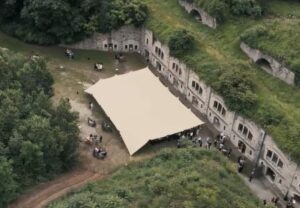
The Fort's architecture follows the principles of Séré de Rivières: moats, caponnières for defending those moats, a raised central cavalier building (the structure that today houses the Cour du Cavalier), and a layered defence logic that still explains the configuration of the spaces. This is not an architectural fancy — every element has a precise military function, and that logic is still legible in the volumes today.
The Fort has been owned by the Town of Feyzin since 2003. Its gradual renovation, carried out in partnership with several public and private stakeholders, has opened the site to a wide range of uses — heritage, cultural, and events, while preserving its architectural character.
What the Fort's History Brings to Your Events
This isn't a question of décor. A venue with a genuine, documented history creates a different experience from a space designed to merely resemble something. Participants feel it.
In practice, the history of Fort de Feyzin gives you several event resources you wouldn't find elsewhere.
A narrative thread for your programme. A guided tour of the Fort can be integrated into your day as a sequence in its own right, a cultural interlude that creates a break in the programme, puts participants at ease, and generates informal conversations between colleagues who don't yet know each other well. It's a cohesion tool that many organisers underestimate until they experience it firsthand.
A backdrop for team buildingThe Fort challenges, trail games through the fortifications, historical escape games, these activities use the architecture and history of the venue as both setting and source of puzzles. It's not the same thing as an escape game in a generic room.
A legitimacy for institutional events. Welcoming partners, clients, or officials in a heritage venue says something about the way a company sees itself and its guests. It's no coincidence that historic venues are so often chosen for partnership signings, awards ceremonies, and gala evenings.
The Fort's Spaces and Their Architectural History
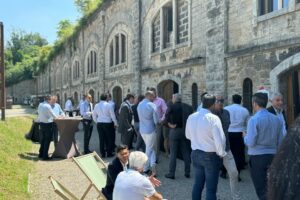
The Caponnière. Historically, caponnières are forward works built within moats to defend them against enemy assault. The Fort de Feyzin's Caponnière, now renovated, is today the site's most emblematic space: its succession of stone alcoves, its lighting, and its volumes make it a naturally dramatic festive venue. 600 m² indoors, 200 m² of outdoor space, up to 200 guests. event spaces page details the available configurations.
The Cour du Cavalier. The Cavalier is the Fort's central raised building — it served as barracks and as a defensive post overlooking the surrounding land. Its 2,000 m² courtyard is today the site's high-capacity space: up to 1,000 guests in cocktail format, 300 for a seated dinner. For large corporate evenings or large-scale events, it is a rare space in the region.
The Théâtre de verdure. Set on the heights of the Fort, above the Caponnière, this 1,000 m² outdoor space offers views across the surrounding park. It is where most outdoor activities and summer receptions take place.
The seminar hub. Three modular rooms of 40 to 150 m², with breakout rooms, for your seminars, training sessions and meetings.
The Fort Within Its Natural Setting
The built site sits within a 26-hectare park classified as a Site of Natural Sensitivity by the Auvergne-Rhône-Alpes Region, a designation that reflects both the ecological richness of the land and the commitments made towards its preservation. This gives a particular resonance to events with a CSR or environmental dimension.
Fort de Feyzin is listed among the event venues recommended by Only Lyon Pro for corporate events in the greater Lyon area, and is referenced by Visiter Lyon among the privatisable venues of the region.
Getting to Fort de Feyzin
The Fort is accessible from Lyon in 15 minutes via the A7 motorway (exit D301, direction Feyzin La Bégude). Free on-site car park with 120 spaces. By public transport, Line 39 connects Vénissieux station (Metro D) to the La Bégude stop in 10–15 minutes, and Line 60 runs from Gerland (Metro B) in 20–25 minutes. Feyzin train station is 2 km away, 10 minutes from Lyon Perrache or Jean Macé.
Before visiting, take a look at our photo gallery to get a sense of the spaces. And if you have a project in mind, contact our team — we're available to discuss it and arrange a visit.