Organising a Corporate Event for Over 300 Guests Near Lyon
300 people. That's the threshold where the usual approach starts to break down.
Not because the event is fundamentally different, the objectives remain the same: bring people together, build cohesion, leave something behind. But the mechanics change entirely. What you can improvise with 80 people needs to be planned with 300. What you can fix on the fly with 150 needs to be anticipated at 500. And venues in the Lyon area capable of handling that scale without the experience suffering are genuinely fewer than you'd think.
What a Large Headcount Actually Changes
The first mistake organisers make when scaling up for the first time: assuming the same rules apply, just bigger. They don't.
- Guest flow. 300 people arriving in twenty minutes is a crowd. If the arrival experience isn't designed — clear signage, multiple entry points, correctly sized cloakrooms, directed circulation — queues form, people wait, and the energy drops before the event has even begun. First impressions are formed in the first ten minutes. At this scale, there's no room for error.
- Catering. Feeding 300 people simultaneously is not the same operation as feeding 80. Preparation space, number of service points, rotation times, available electrical capacity for cooking equipment, everything needs to be resized. A caterer used to small groups in a venue without the right infrastructure is the classic recipe for a lunch that overruns into the afternoon by an hour.
- Technical production. A sound system that covers a room of 80 people won't cover a 2,000 m² courtyard with 500 guests. Stage lighting, video, outdoor sound distribution, everything scales up, and the venue needs the electrical infrastructure to match. Checking available power capacity before signing anything is not a detail.
- Collective atmosphere. This is the paradox of large events: the bigger the group, the more fragile the cohesion. A space that's too vast dilutes energy, people scatter, conversations fragment, the sense of collective belonging evaporates. A space that's too tight creates uncomfortable pressure. The right ratio between headcount and venue volume isn't something you improvise.
The Questions to Ask Before Booking
Sales teams don't spontaneously raise the uncomfortable issues. That's your job.
- Actual capacity vs. stated capacity. A venue announces 400 guests in cocktail format? Ask for the exact surface area and configuration. Stated capacity often includes circulation zones, service areas, and corners where nobody actually stands. The real usable surface is always lower than the advertised figure.
- Parking. 300 attendees arriving by car means 100 to 150 vehicles. A car park with 50 spaces means you need a shuttle or very precise communication about alternatives, two additional constraints to manage before the day itself.
- Modularity. A large event changes format throughout the day: plenary in the morning, lunch, breakout sessions, evening. A venue with a single large space means heavy setup and breakdown between each sequence. A venue with several complementary spaces lets the event breathe.
- On-site team. At this scale, you need someone who knows the venue inside out, who coordinates suppliers in real time, and who makes decisions without waiting for your instructions. A venue without a dedicated team leaves you alone when something goes wrong.
- Service access. Caterer deliveries, technical setup, artist entrances, all of this needs to reach the site without crossing paths with guests. A well-designed venue separates these flows. A poorly designed one turns your morning into chaos.
The Formats That Work at This Scale
Not all event formats suit large headcounts. A team building event that's too large dilutes cohesion. A training session becomes a lecture. Other formats, however, gain in power with numbers.
Annual convention or commercial kick-off. Opening plenary, breakout workshops, lunch, collective wrap-up, evening celebration, a day that marks the beginning of a year or a project. Large headcounts are an advantage here: they produce a sense of belonging that smaller gatherings simply can't replicate.
La Gala corporate evening . Prestige dinner, awards ceremony, year-end party, these events draw their strength from the numbers. A full room, a rising atmosphere, an energy that only a large gathering produces. More on our corporate evening page.
Le Large-scale product launch . Press, partners, distributors, and internal teams gathered at the same moment in a memorable venue. A dynamic impossible to reproduce through separate communications. See our product launch article for more.
Le Multi-team seminar. Geographically dispersed colleagues brought together for a day, with spaces capable of hosting the shared plenary and breakout sessions without any displacement between the two.
What Makes the Difference on the Day
Large events don't fail on content. They fail on logistics.
- A single, dedicated project manager. On site from setup to the departure of the last guest. Someone who knows the file in every detail. Who makes decisions in real time without calling someone else first.
- Suppliers who know each other. Caterer, technical crew, entertainment, security, when these teams are used to working together on the same site, friction disappears. They anticipate each other's constraints without waiting for your instructions.
- A contingency plan for every critical sequence. Weather, late speaker, technical incident, at this scale, nothing gets resolved by improvisation. Every sequence needs a prepared alternative scenario, with resources confirmed and teams briefed on the trigger.
- Carefully managed transitions. In a large event, the moments between sequences matter as much as the sequences themselves. A poorly handled transition leaves 300 people in limbo for ten minutes. Recovering from that is hard.
Why Fort de Feyzin Is the Right Venue at This Scale
To be direct: venues genuinely capable of welcoming 300 to 1,000 people near Lyon are few. Many advertise capacities they don't hold in real usable surface area. Many have no team capable of supporting complex events. Many have a single large space, without the modularity needed for a full day's programme.
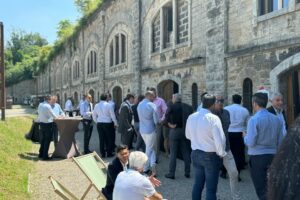
The Cour du Cavalier at Fort de Feyzin spans 2,000 m². It accommodates up to 1,000 guests in cocktail format, 500 in plenary, 300 for a seated dinner. These figures reflect real usable surface area, not a theoretical optimum. The Caponnière (600 m²) holds up to 200 guests. The seminar hub (500 m²) handles breakout groups. The Théâtre de verdure (1,000 m²) manages outdoor activities. Full details are on the event spaces page.
Plenary in the Cour du Cavalier, workshops in the seminar hub, lunch in the Caponnière, activities in the Théâtre de verdure, evening back in the Cour, every sequence has its own space. No setup or breakdown between highlights.
120 free on-site parking spaces. Line 39 from Metro D (Vénissieux), Line 60 from Metro B (Gerland). The A7 motorway, exit D301, 15 minutes from Lyon. Arrival logistics are sorted for the vast majority of attendees.
One dedicated project manager per event. A network of suppliers, caterers, technicians, entertainment providers, security, who know the site and work together regularly. That's what allows the organiser to experience the event rather than endure it.
And the setting: a 19th-century fort surrounded by 26 hectares of protected forest classified as a Site of Natural Sensitivity by the Auvergne-Rhône-Alpes Region, owned by the Town of Feyzin. The site's history is documented at lefortdefeyzin.fr. It's a venue that generates immediate buy-in from attendees, something no decoration can replicate. Fort de Feyzin is listed by Only Lyon Pro and Visiter Lyon among the event venues of the greater Lyon area.
You have a large event to organise ? Contact our team to discuss it. The photo gallery will give you a sense of what the Fort can offer at this scale.